

 Should robots walk or roll? While the answer to this question is obvious for certain applications, it has implications for the entire robot industry, and society as a whole.
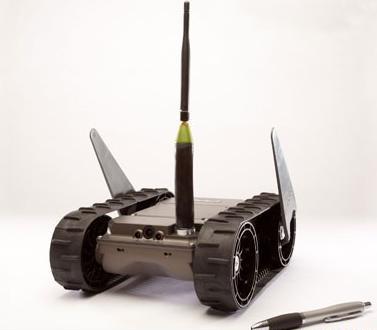
Colin Angle, CEO of iRobot, has seen the future of robots, and they aren’t walking. In an interview with Pilots Presence (reprinted in IEEE Spectrum), Angle criticized the millions of dollars spent on developing bipedal robots. These systems often require large groups of support personnel during operation, and have a Mean Time To Failure of 45 minutes. Angle compares these delicate, slow-moving, humanoid systems to the robust iRobot Warrior UGV, which uses treads. Watch this video of the Warrior 710 running rampant over rocks and up stairs, and you will understand his preference for non-legged robots. Wheeled/treaded robots are cheaper, simpler, and more rugged. Read more



 Recently, some clients asked AMREL to build an Operator Control Unit (OCU) for their Unmanned Ground Vehicle. No surprise there; we dominate that particular application. What was noteworthy was the specific form factor that they requested. They wanted it to be a wearable computer, worn on the wrist.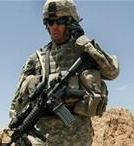
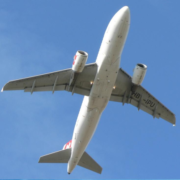
 One of the hottest topics in the unmanned systems community is civilian applications. As Smithsonian.com reports in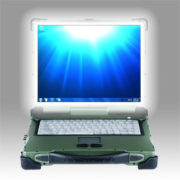
 Let’s assume that you already maxed out the brightness controls. Did you check the power management? If you’re running the laptop on batteries, it will often default to power savings mode, which will dim the screen. Also, crank up the contrast ratio to 5 to 1 or even higher. Does your computer think it’s dark out? Verify the dimming range is adjusted for the daytime, not the night. Adjust the viewing angle of the display screen. It sounds trivial, but the angle can make a big difference in how the screen is viewed.
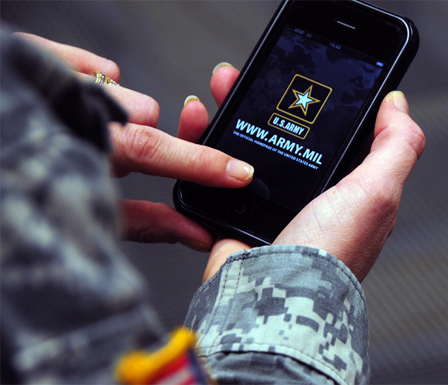 What is the optimal screen size for a mobile device used by a warfighter? Is it the 7″ to 12″ display of the tablet? The 3″ to 5″ of the smartphone? Something in-between?