The Association for Unmanned Vehicle Systems International recently held its annual North America show, and AMREL was
Robotics System Joint Project Office (RSJPO) there! In addition to our booth showing off AMREL’s new interoperable payload controller, AMREL’s OCU solutions were displayed by a multitude of vendors, including: Read more
One of the hottest topics in the unmanned systems community is civilian applications. As Smithsonian.com reports in Drones Ready for Takeoff:
“The potential seems limitless—handling routine monitoring of pipelines and power lines, for instance, or gathering geomagnetic data about natural resources (a job that entails flying hundreds of miles in a straight line, at low altitude, then moving 50 yards over and flying straight back). Drones could help farmers monitor crops in distant fields, allow real estate developers to perform simple construction jobs in remote or difficult locations or enable environmentalists to spot polluters.”
I don’t know about you, but I am sick of certain clichés about unmanned systems and combat. It’s just my opinion, but some commonly repeated statements confuse, rather than clarify. Here are a couple of my “favorites.”
“The use of unmanned systems in combat will destroy the warrior ethos.”
I’m sure you’ve heard this. “They’re cowards, these so-called ‘soldiers’ who strike from afar. A real man confronts his enemy face-to-face. These new weapons should be banned.”
Of course, this quote is from a French nobleman talking the English archers and their long bows. The whole argument about the unmanliness of “death from afar” probably started the first time someone threw a rock. This line of reasoning ignores the fact that war isn’t about building soldierly virtues; it’s about winning (or to paraphrase Patton, “Making the other guy die for his country”). Read more
https://amrel.com/wp-content/uploads/2013/10/Anti_cliche.jpg358318William Finnhttps://amrel.com/wp-content/uploads/2017/04/amrel_logo300-225x60dpi.jpgWilliam Finn2011-08-02 21:30:002017-07-11 12:09:17Clichés about unmanned systems that I can do without
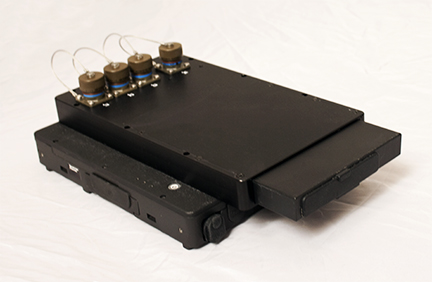
AMREL releases the first Payload Controller that uses swappable, field-expedient Radio Control Modules (RCMs). Radio components are integrated into the RCM, which fit into AMREL’s revolutionary swappable device bays. RCMs can be easily switched in and out by ordinary personnel, enabling it to easily change applications.
Developed under AMREL’s Flexpedient® Technology, RCMs were first used in AMREL OCU solutions. RCMs enabled AMREL to be the first company to produce an OCU solution that could control heterogeneous unmanned systems – even when they have diverse operating systems and different origins of manufacture. Read more
An IEEE Spectrum article features an Al Jazeera video (see below) about Libyan rebels making their own weapons. The rebels transform a child’s toy into a weaponized UGV, prompting IEEE to conclude that “Anyone can (on principle, at least) build a robot, and given the need or the motivation, anyone can put a gun on one…”
00William Finnhttps://amrel.com/wp-content/uploads/2017/04/amrel_logo300-225x60dpi.jpgWilliam Finn2011-07-22 02:09:002017-07-11 12:09:17Libyan system integration video
Officer.com recently ran an introductory article about Public Safety using what in the Defense world are referred to as Tactical Unmanned Aerial Vehicles (TUAV). No runway needed describes various applications, which for the most part, are the civilian equivalent of Intelligence, Surveillance, and Reconnaissance (ISR).
Experts are repeatedly quoted that the technology not only exists for Public Safety applications, but also is extremely mature. The two main challenges are delivering solutions that are economical enough for cash-strapped civilian agencies, and, of course, FAA regulatory fears about mid-air collisions. Read more
There’s nothing quite like the prospect of a half of a billion dollars to get the blood pumping, the brain scheming, and the pundits pontificating. The President’s ambitious Advanced Manufacturing Partnership (AMP), which includes $70 million for robots, may not revive the American manufacturing sector, but it certainly has provided fodder for the technology media. Read more
Despite the ad with the drumming bunny, batteries in unmanned systems do not last forever. In fact the performing rabbit robot’s power lasts only three to four minutes.
Battlefield robots do better (a typical UGV batteries may last about 2 hours), but power is a huge challenge. This seems counter-intuitive, since one of the main advantages of unmanned systems is that, by definition, they don’t have to lug around people. However, mobility is only one source of power consumption. Communications and cooling systems may actually be more of a drain than simple transport. Read more
https://amrel.com/wp-content/uploads/2017/04/amrel_logo300-225x60dpi.jpg00William Finnhttps://amrel.com/wp-content/uploads/2017/04/amrel_logo300-225x60dpi.jpgWilliam Finn2011-07-05 21:17:002017-07-11 12:09:18Don’t believe the bunny: Power & Unmanned Systems
Flexpedient® Technology enables one computer to run a variety of applications, including robotics and biometrics. This field-expedient system allows developers to protect proprietary technology while deploying it in an interoperable solution. To see just how simple it is, watch this video.
The direction for unmanned systems and all of the Defense community is clear; we must do more with less and do it faster. We need to create the best possible systems for tomorrow’s needs as soon as possible. One niggling little problem: what does tomorrow look like?
For example, do we develop unmanned systems with multiple assets or a single asset? Which payload configuration will be desirable for the future warfighter?
The obvious answer would seem to be, the more the better. Take the case of Sensitive Site Exploitation (SSE). Soldiers would love to have a robot that can enter a potentially dangerous house and clear it with non-lethal stun grenades. Of course, any armed application should be matched with optical surveillance capabilities as well. Olfactory sensors would be valuable in detecting explosives. When you add to the wish list an IED jammer and maybe the ability to detect ABC weapons, a multiple-asset unmanned system seems virtually certain. Read more
https://amrel.com/wp-content/uploads/2017/04/amrel_logo300-225x60dpi.jpg00William Finnhttps://amrel.com/wp-content/uploads/2017/04/amrel_logo300-225x60dpi.jpgWilliam Finn2011-06-23 21:41:002017-07-11 12:09:18Multiple or Single Assets for Unmanned Systems?
We may request cookies to be set on your device. We use cookies to let us know when you visit our websites, how you interact with us, to enrich your user experience, and to customize your relationship with our website.
Click on the different category headings to find out more. You can also change some of your preferences. Note that blocking some types of cookies may impact your experience on our websites and the services we are able to offer.
Essential Website Cookies
These cookies are strictly necessary to provide you with services available through our website and to use some of its features.
Because these cookies are strictly necessary to deliver the website, refusing them will have impact how our site functions. You always can block or delete cookies by changing your browser settings and force blocking all cookies on this website. But this will always prompt you to accept/refuse cookies when revisiting our site.
We fully respect if you want to refuse cookies but to avoid asking you again and again kindly allow us to store a cookie for that. You are free to opt out any time or opt in for other cookies to get a better experience. If you refuse cookies we will remove all set cookies in our domain.
We provide you with a list of stored cookies on your computer in our domain so you can check what we stored. Due to security reasons we are not able to show or modify cookies from other domains. You can check these in your browser security settings.
Google Analytics Cookies
These cookies collect information that is used either in aggregate form to help us understand how our website is being used or how effective our marketing campaigns are, or to help us customize our website and application for you in order to enhance your experience.
If you do not want that we track your visit to our site you can disable tracking in your browser here:
Other external services
We also use different external services like Google Webfonts, Google Maps, and external Video providers. Since these providers may collect personal data like your IP address we allow you to block them here. Please be aware that this might heavily reduce the functionality and appearance of our site. Changes will take effect once you reload the page.
Google Webfont Settings:
Google Map Settings:
Google reCaptcha Settings:
Vimeo and Youtube video embeds:
Other cookies
The following cookies are also needed - You can choose if you want to allow them:




 One of the hottest topics in the unmanned systems community is civilian applications. As Smithsonian.com reports in

 here’s nothing quite like the prospect of a half of a billion dollars to get the blood pumping, the brain scheming, and the pundits pontificating. The President’s ambitious Advanced Manufacturing Partnership (AMP), which includes $70 million for robots, may not revive the American manufacturing sector, but it certainly has provided fodder for the technology media.
 community is clear; we must do more with less and do it faster. We need to create the best possible systems for tomorrow’s needs as soon as possible. One niggling little problem: what does tomorrow look like?